.svg)
Every Campus Ready.
Every Sideline Covered.


Affton School District is a tight-knit community in suburban St. Louis, MO. On any given day, its campuses serve students, staff, parents, volunteers, and visitors. Facilities are rented out often, and Friday nights draw crowds, so the number of lives on campus at any moment is far larger than enrollment alone suggests.
When the district decided to modernize its AED program, it didn't just replace devices. It standardized every campus with a rollout of 27 Avive Connect AED®s, built a placement plan around a 3-minute response goal, and gave its nurses and athletic trainers a new way to stay ready without the manual work.
A Patchwork Program That Put Time and People at Risk
Before Avive, Affton's AEDs had been bought one at a time as needs arose. The result was four or five different models in each building.
Some AEDs had signage and some didn't. What did exist varied from unit to unit.
Older models required a different set of pads for pediatric patients. In an emergency, a responder would have to work out which model they were holding and swap pads before delivering a shock.
“Having to stop, figure out which of the four models you're holding, physically swap out the pads for pediatric pads, could severely delay that time to shock.”
School nurses were responsible for monthly checks. That meant walking the halls, checking batteries, tracking pad expiration dates, and keeping logs, all while learning the different maintenance requirements of each device.
“There was no consistency across the board with our previous AEDs.”
The district's athletic trainers covered 200+ athletes across practices, home games, off-campus matches, and middle school events. Without a truly portable AED, they relied on larger units stored in a shed, or on whatever the host school had, if anything.
One Web Search,
One Clear Choice
Adam Jasinski oversees Affton's technology infrastructure and its safety and security operations, and he is always looking for ways to use connectivity to solve operational problems. When the district's AEDs came due for replacement, he started with a simple search.
What he found was an AED that connects over Wi-Fi and cellular and reports its own health status automatically.
“It was literally one Google search, and third result, maybe, I looked at where I saw Avive, and I'm like, 'Ah, I think this one's going to be the one.'”
Mapping the Walk to 3 Minutes
Affton didn't place their 27 Avive Connect AED®s where there happened to be wall space. The district set a goal of reaching an AED within three minutes from anywhere on campus and built its plan around it.
Start with the big spaces
Adam and the nurses walked each building and prioritized large-occupancy areas such as cafeterias and auditoriums. They also covered common spaces where the public gathers, like the football field.
Study the floor plans
Using building maps, they asked how long it would take someone to walk to the nearest AED and where the next one should go.
Drill it
The nursing and administrative teams ran mini-drills, walking to the farthest corner of a field and to the corner classroom that's easy to overlook.
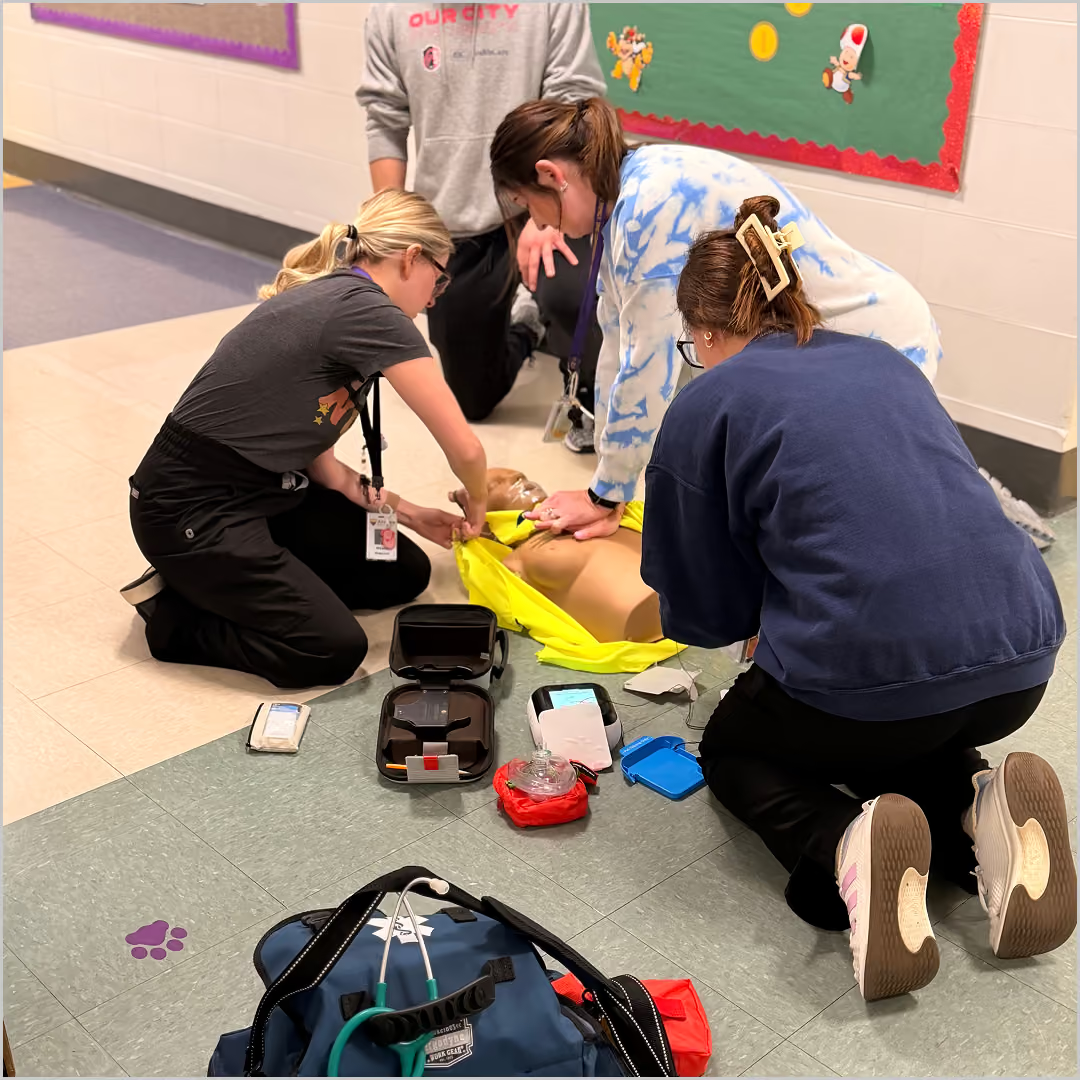
Affton's rollout focused on familiarity. The nursing team trained with Adam through hands-on sessions, instructional videos, and practice in Avive's Training Mode. Swappable training pads let nurses demonstrate exactly how the unit they'll use in a real emergency works, with the device in hand.
Athletic trainers received a quick walkthrough from Adam covering how to power on, pull the pads, and respond. Both already had extensive AED experience, and the intuitive design meant they needed little else.
“You want to create that muscle memory. You want it to be the same way every time, and work the same way every time.”
What Changed for Each Team
Avive's REALConnect™ platform gives Adam and the district nurse coordinator a view of every AED in the district. Each building nurse can see the devices in their own building.
“We're all able to have an all-hands-on-deck approach, which takes it a little off of just the building nurse to be responsible for all of the AEDs within their building.”
Automated readiness checks and reporting replace manual walkthroughs and paper logs, so leadership can confirm that every AED is ready.
Nurses who used to walk the halls checking batteries and pads now have the same dashboard view as district leadership.
“That's definitely helped them with not having to go do those manual maintenance checks and pad swaps, for sure.”
One pad set also covers adults and children. Pulling the pads from the device replaces opening packages and choosing a size.
“Having a one-size pad that can be used for both a child and adult is very helpful.”
Older AEDs often look like intimidating medical equipment. Avive doesn't. Pull the tab at the top, and the device guides the responder with on-screen visuals and clear audio prompts. A dedicated Child Mode button removes any doubt about what to do for a younger patient. CPR instructions are built in for responders without formal training, and the device can speak in Spanish.
“It's very clear you pull on the top, and then it walks you through visually and with the audio prompts on what to do.”
Becky Stigen has been Affton's athletic trainer for 18 years. She and her colleague cover 200+ athletes (along with coaches, parents, visitors, and staff who may be spectating). Now they each carry a portable Avive AED.
Their coverage goes beyond campus. They travel with football, cover off-campus tennis matches and middle school events, and may soon support teams visiting schools that have no athletic trainer. At away venues, they often don't know where the AED is, whether there is one, or who has the key.
“We don't want to be spending 5 minutes tracking down an administrator to get us in this building. So that immediate access, having it right there in my kit, you just can't go wrong.”
Project ADAM Heart Safe School District
Affton's AED program is one part of a broader cardiac readiness strategy. The district partnered with Project ADAM to pursue Heart Safe School District status. The effort included mapping AED locations to meet the 3-minute response goal, monitoring devices through the dashboard, writing a cardiac emergency response plan for each school community, and running annual training and cardiac drills.
From there, Project ADAM certified that the school district demonstrated strong cardiac emergency preparedness through awareness, training, and a practiced response plan. They met the standards outlined in the Heart Safe School Program Checklist, reflecting their commitment to a safer environment for students, staff, and visitors.
Features Behind the Results
REALConnect™ automates readiness checks and reporting. Staff don't have to walk the halls to confirm devices are charged and pads are current.
QuickRescue™ 911 notification helps get emergency responders moving.
Intuitive, guided prompts let non-medical staff use the AED successfully.
Child Mode and a single pad set streamline response for children and adults alike.
Training Mode with swappable training pads lets teams rehearse on the exact device they'll use.
At 2.1 lbs, the compact, lightweight design means athletic trainers can carry an AED to every practice, game, and away event.
Cardiac arrest response is a shared responsibility.
Schools are responsible for the safety of students, staff, and the wider community, and emergencies have to be manageable by people who aren't medical professionals. Managing campus AEDs shouldn't be a burden, and it shouldn't be a reason to go without them. Affton shows what's possible when a district connects its people, its plan, and its devices.